
Enterprise dentistry has two long-balanced competing truths: great clinicians are busy clinicians — and great clinicians don’t always have time to coach the next generation.
Dr. Greg Kerbel, P4D’s Chief Clinical Officer, was once a practicing dentist himself and knows what it’s like to work under pressure. With nearly 40% of dentists nationwide reporting that they feel overworked or stretched too thin to meet patient demand, the need for clinical support systems has never been higher.
At the same time, P4D has been actively recruiting younger dentists to meet growing demand. The challenge: how do you support unseasoned doctors without burning out your veterans — and still deliver consistent, high-quality care? And how do you ensure everyone is delivering effective diagnostic care?
For Kerbel, the answer was Pearl.
Onboarding Without the Hand-Holding
Staffing challenges have become nearly ubiquitous among dental practices in the wake of a national clinician shortage. According to the Health Resources and Services Administration, the U.S. needs over 10,000 additional dentists to meet current care needs — and over 60% of practices cite staffing as a top challenge.
For P4D, like many organizations, that meant bringing in new dentists while maintaining the highest quality care.
“Younger doctors just lack confidence,” Kerbel said. “They’ve come from dental school where every reading is reviewed and second-checked.” In the operatory, there is no safety net.
Pearl’s AI-powered radiologic software offered a solution: a digital mentor that provides consistent, judgment-free support and ensures an accurate diagnosis.
“If we’re bringing an unseasoned doctor into a seasoned office, wouldn’t we want to equip them with the best tools in the business?” Kerbel said. “Pearl does that. It ramps them up quicker, more formidably, with greater efficacy — not just efficiency.”
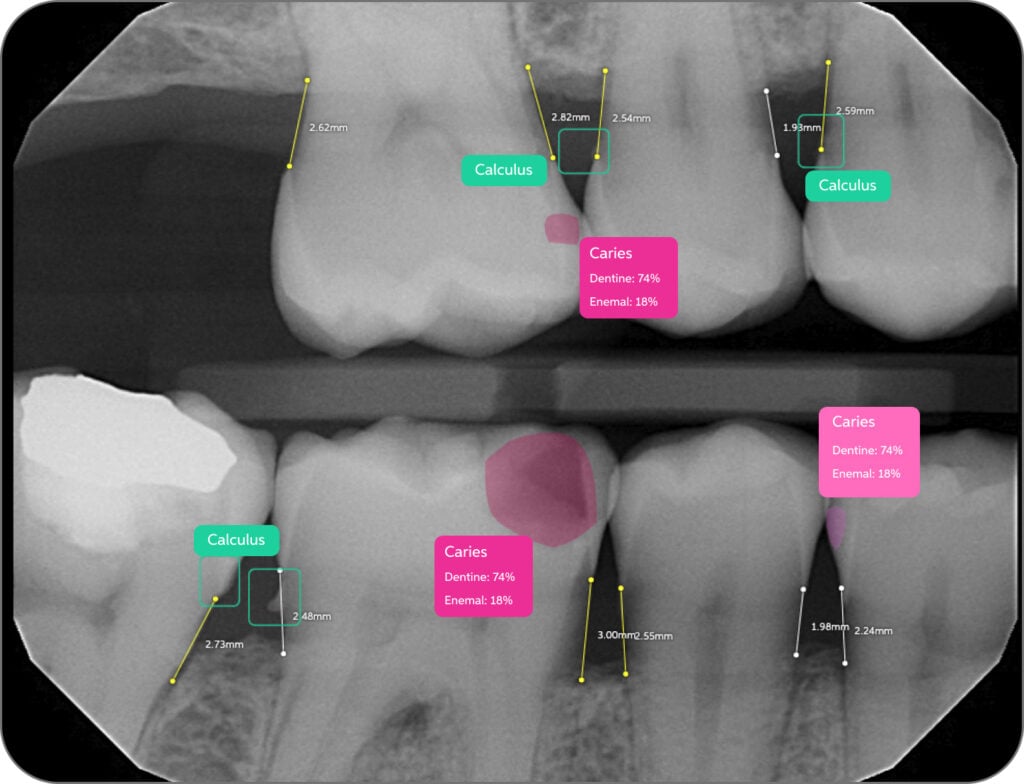
New clinicians now have a quiet partner reviewing every radiograph, flagging possible decay, bone loss, calculus, and more — right there on the screen, in color.
“Pearl gave the doctor the ability to say, ‘I believe I know what I’m seeing, but it sure would be great if I had a mentor that wasn’t judgmental looking over my shoulder 24/7.” Kerbel said. “Pearl allows that to happen. Pearl shows up every day. Pearl’s never sick. Pearl’s always supportive.”
A Second Set of Eyes for the Experts
Even for P4D’s most experienced providers, the pace of modern dentistry means things can get missed.
“Reading radiographs doesn’t take that long,” Kerbel said, “but it also doesn’t take very long to misread one either.”
Senior clinicians sometimes rely on hygiene summaries or assistant notes to stay on schedule — but that kind of relay system isn’t foolproof. That’s where Pearl comes in.
“Pearl is never rushed.” Kerbel said. “It’s always faster than we are — and it’s always thorough. We want to be efficient, yes. But more than that, we want to be efficacious. We don’t want to miss lesions. We don’t want to over diagnose. And we certainly don’t want to underdiagnose.”
Now, when a provider reviews radiographs, they’re seeing them through both human and AI eyes. Pearl flags the areas of concern, helps confirm findings, and elevates the quality of treatment planning across the board.
Results That Speak for Themselves
The results of bringing Pearl into P4D’s workflow have been measurable—and dramatic. After about five months of consistent use, diagnoses are up and treatment plans are more advanced.
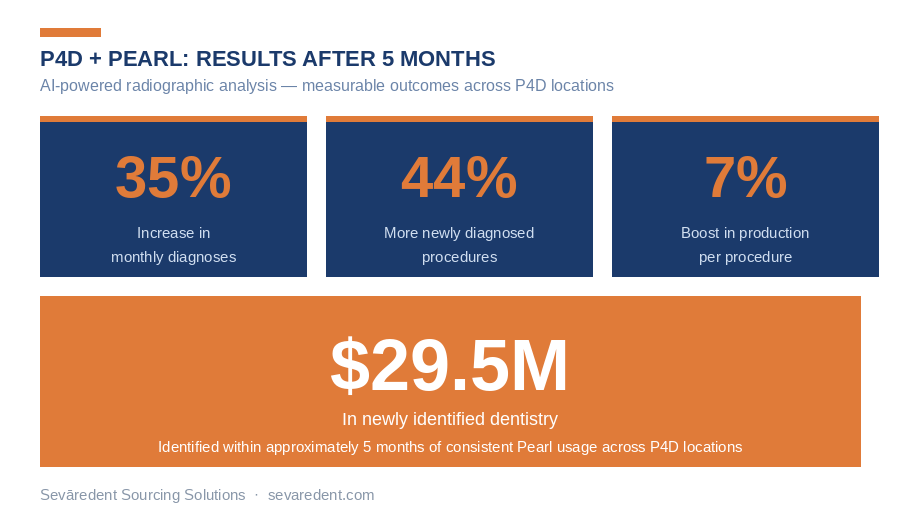
But beyond the numbers, Kerbel says the real value lies in the quality of care and clinician confidence.
“What we’re seeing is that doctors now walk into the room and review areas already highlighted by Pearl,” he said. “Lesions that might’ve been missed before are now part of the treatment conversation. That means higher treatment plan conversion — and more comprehensive care.”
Pearl’s visual clarity also helps patients understand their diagnoses.
“The patient says, ‘Yeah, I see that — it’s in color.” Kerbel noted. “They don’t understand shades of gray, but they understand pink, red, green. It’s easier for them to believe what we’re saying.”
Scaling Consistency Across the Organization
What began as a tool to support new hires has become a system-wide asset at P4D.
“Pearl helps us deliver consistency, coaching, and clarity across every office.” Kerbel said. “It helps young doctors become confident providers. It helps seasoned clinicians work more safely. It helps patients say yes to treatment. And it does all that without adding more burden to the team.”
For an organization that’s growing fast, that kind of support is essential.
“This is what it looks like when technology really delivers on its promise.” Kerbel said.
INSIDE THE ADOPTION STRATEGY
How P4D Turned AI Adoption Into a Competition — and Won
When it came time to get his teams fully engaged with Pearl, Dr. Greg Kerbel didn’t rely on mandates — he turned to motivation.
To encourage consistent use of Second Opinion and reinforce the value of early-stage diagnosis, P4D launched a month-long internal competition: the practices that reviewed the most radiographs in Pearl and placed the most applications of Curodont, a non-invasive treatment for incipient lesions, would win a prize.
RESULTS: The top two practices — Frisco and Lubbock — not only led in Curodont usage but also led in Pearl adoption, reviewing 65% of their X-rays with AI. The correlation between AI engagement and preventive treatment placement was impossible to ignore. The hygiene teams were particularly engaged.
“It allowed them to be able to begin doing treatment on decay that they were never able to do before, because they couldn’t see it. Now they can see it and they have an answer in Curodont,” Kerbel said.